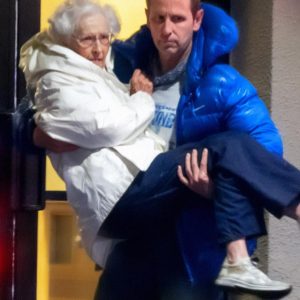
Karen Marsh Doll offers a different kind of living history. As one of the last surviving figures from Hollywood’s golden age, she embodies the final threads of a studio system that once dictated style, narrative, and culture. Doll’s life is a bridge from the sets of The Wizard of Oz and Gone with the Wind—movies that shaped American imagination—to a world that barely recognizes the machinery and meticulous craftsmanship that created them. She remembers the lights, the cameras, the whispers of directors, and the subtle rituals that went into crafting icons. In conversation, her recollections flow effortlessly, transporting listeners back to a time when Hollywood was both magical and relentless, nurturing careers while demanding absolute devotion.
Then there is Ray Anthony, the living embodiment of swing and swagger, whose 103 years have not dulled his performance or his spirit. Anthony represents an era when big bands defined romance, where the rhythm of a brass section could shape the arc of a dance hall or the trajectory of a young lover’s heart. Even today, he carries that energy, still performing, still holding the attention of audiences who know little of his contemporaries yet feel the power of his presence. With him, music is not a relic; it is a living, breathing force, proof that artistry—like life—can thrive well beyond what we imagine.
Around them, a constellation of icons keeps shining. June Lockhart, Eva Marie Saint, and Dick Van Dyke exemplify warmth and wit that outlast decades. Their work is as recognizable as it is enduring, yet it is their humanity that resonates most. Lockhart’s gentle gravitas, Saint’s luminous elegance, and Van Dyke’s playful charm demonstrate that charisma, compassion, and professionalism do not fade with time. They are reminders that longevity in the arts is as much about character and dedication as it is about talent.
Then there are those who continue to defy expectations through creation itself. Mel Brooks, William Shatner, and Barbara Eden are still active, mentoring, innovating, and performing well into their later years. Brooks, whose genius shaped comedic cinema, demonstrates that humor does not age out; it evolves. Shatner, whose voice and presence became inseparable from pop culture through decades of television and film, continues to engage audiences with a blend of self-awareness and audacious performance. Eden, immortalized as a magical genie on screen, remains a figure of grace and delight, proving that joy in creation can be timeless.
Clint Eastwood, Sophia Loren, and Michael Caine offer further testament to artistry as evolution rather than retirement. Eastwood, a living legend of American cinema, continues to direct, act, and produce with a precision that belies his years. Loren’s elegance and craft have not dimmed; if anything, her presence carries a deeper authority and charm accrued from decades of experience. Caine, whose career spans everything from gangster films to grand epics, shows that adaptability and passion are the key to enduring relevance. For all three, age has not narrowed opportunity—it has deepened it, allowing mastery of craft to intersect with lived wisdom.
Meanwhile, Julie Andrews, Shirley MacLaine, Al Pacino, and Jane Fonda extend their influence beyond performance into activism, mentorship, and cultural commentary. Andrews, whose voice defined generations, now engages in advocacy and education, bringing the same meticulous discipline to causes that she once brought to music. MacLaine’s fearless exploration of film, philosophy, and personal experience demonstrates the breadth of what a life in the arts can encompass. Pacino, whose intensity has never wavered, continues to challenge himself, embodying characters that speak to contemporary struggles while honoring decades of dramatic tradition. Fonda, unflinching in her political engagement, underscores the principle that relevance is not a measure of age, but of courage, commitment, and the willingness to confront both personal and societal truths.
Together, these artists form a living archive—a network of memory, influence, and resilience that documents the evolution of culture over nearly a century. Their presence is both inspiration and challenge: inspiration in their vitality, creativity, and ongoing engagement with the world, and challenge in their implicit reminder that time is never the ultimate arbiter of relevance. These figures collectively show that passion, dedication, and intellect can outlast the conventional boundaries of youth, beauty, or societal expectation.
Their lives illuminate the interplay of continuity and change. They have witnessed the rise of television, the dominance of cinema, the digital revolution, and the globalization of culture. They have adapted to each shift without losing the essence of their craft, demonstrating that true artistry is flexible yet grounded in principle. From the intricate compositions of Elizabeth Waldo to the larger-than-life persona of Ray Anthony, the glamour and precision of Karen Marsh Doll’s Hollywood memories, and the ongoing contributions of creative legends still active today, we see a spectrum of human achievement that refuses to be constrained by age.
Perhaps most remarkable is the resilience underpinning each story. Longevity in the arts is not merely a function of health or luck; it requires endurance, reinvention, and courage. It demands navigating industry upheavals, cultural shifts, and personal challenges while maintaining a commitment to craft. These figures embody that perseverance. Each has faced moments of doubt, scrutiny, and change, yet each continues to emerge with relevance and impact. Their work is not a relic of history but a living testament to the possibilities of continued creativity and influence.
Their influence extends far beyond the stage, the screen, or the concert hall. They mentor younger artists, speak to aspiring performers, and remind audiences that experience is invaluable. They remind us that artistry is cumulative, a dialogue across generations, and that the lessons embedded in decades of practice cannot be replaced by novelty alone. For those who watch them, these icons offer both a history lesson and a blueprint for enduring passion: engage fully, adapt constantly, and never relinquish the pursuit of excellence.
In the end, their presence is a quiet rebellion against the cultural obsession with youth. In a world often obsessed with immediacy and disposable fame, they stand as proof that relevance, impact, and vitality are not confined to age. Instead, they suggest that mastery, empathy, innovation, and courage—qualities refined over time—are the true measures of lasting achievement. Their lives remind us that the human spirit, when cultivated with dedication and creativity, can continue to shine brilliantly, even as decades pass.
From Elizabeth Waldo’s ethereal compositions to Ray Anthony’s enduring swing, from Karen Marsh Doll’s firsthand Hollywood memories to the continued contributions of Eastwood, Loren, Caine, Andrews, MacLaine, Pacino, and Fonda, these living legends exemplify the intersection of history, craft, and resilience. They carry the past forward while continuing to shape the present, proving that time may change us, but it need not limit us. Each day, each note, each performance, each appearance, is a declaration: artistry, courage, and relevance are boundless when fueled by dedication and heart.
In celebrating them, we celebrate not just their achievements but the possibilities inherent in a life fully lived. They are reminders that brilliance is not fleeting, that influence is cumulative, and that the spirit of creativity can endure beyond expectation, beyond assumption, and beyond the supposed limits of time itself. In their lives, we witness the extraordinary capacity of human beings to adapt, to inspire, and to shine—no matter the years that pass.