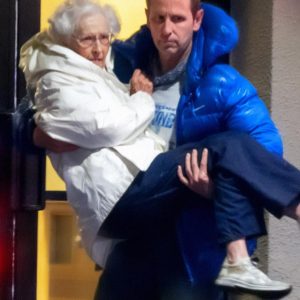
Neighbors later said they hadn’t heard much from the house those last weeks—not the rustling of curtains, not the sound of her music, not even his steady footsteps on the porch. It was as if the home itself was holding its breath. He stayed by her side each night, sleeping in a chair because she no longer wanted the weight of another body near her. When she screamed, he whispered comfort. When she trembled, he placed his hand over hers until her breathing slowed. But nothing slowed for long. Pain circled back every hour. She grew terrified of waking. Terrified of lasting. Terrified of outliving her own mind. And every time she surfaced from the haze of her medication, she asked him again, as if he alone could grant her release: “Please… don’t make me stay.” He tried to tell her he couldn’t, he tried to promise she would find relief in her sleep, he tried to pray that doctors would find some way to ease her suffering. But illness can be merciless. And love, when stretched to its most painful edge, can blur the line between devotion and desperation. In that house heavy with silence, something inside him cracked—not loudly, not suddenly, but the way ice fractures beneath deep snow, unnoticed until it shifts everything at once.
When the sirens came, they didn’t just respond to a single home; they arrived to a collision of love, sorrow, and moral uncertainty that echoed far beyond that quiet street. The paramedics stepped into a room where her body lay still at last, her face softened into a peace she hadn’t known in months. He didn’t run. He didn’t argue. He didn’t pretend. He simply told them what he had done in a voice that was heartbreakingly steady. At the station, he didn’t ask for a lawyer at first—he asked whether she had looked calm when they found her. “She was afraid of suffering,” he murmured, “not of dying.” Some officers looked at him with pity, others with stern detachment, but none could deny the complexity of the moment. What makes a person cross that line? What makes love turn toward a choice that the law condemns? Families across town followed the story with their own fears tucked tightly beneath their ribs—fears of aging parents, of degenerative illnesses, of watching someone they love disappear behind pain that medicine could only temporarily dull.
In the courtroom, he did not defend himself with theatrics or defiance. He simply explained her suffering in plain terms, the way a man might describe weather he could neither change nor outrun. The prosecution spoke of legal definitions, of intent, of boundaries that cannot be crossed even in the name of compassion. They painted his act as a betrayal of vows—“in sickness and in health” meaning you endure suffering, not end it. But the defense spoke with a different cadence, quieter and more intimate. They described a man who had become a full-time caretaker, who fed her, bathed her, held her through nights of screams, who lost sleep and weight and hope long before he ever lost his wife. They spoke of a woman who had once been vibrant and mischievous, who deteriorated into a shadow unrecognizable even to herself. They didn’t romanticize what he had done, but they asked the jury to consider not only the act, but the context—the unbearable reality behind closed doors, where pain distorts everything, including what we believe we are capable of. What unfolded was not a question of guilt so much as a societal reckoning: How do we judge a choice made at the very edge of human endurance?
Outside the courthouse, the world responded with a mixture of outrage and empathy. Some called him a monster. Some called him a saint. Talk shows debated whether mercy could ever justify crossing the law’s threshold. Lawmakers argued about slippery slopes and end-of-life autonomy. Medical professionals weighed in, describing the haunting frequency with which families whisper, “There must be another way.” And ordinary people—neighbors, coworkers, family members of the terminally ill—felt something deeper, a fear rarely spoken aloud: the fear of lingering in a body that has lost its peace, of being trapped in suffering long after life’s sweetness has faded. Behind every opinion was a personal story. A father who died begging for relief. A grandmother who forgot her children. A spouse who lingered in agony for months, tethered to machines that prolonged breaths but not life. His case became more than a legal proceeding; it became a mirror reflecting a truth many avoid until they can’t anymore: love can demand choices the world is not prepared to forgive or understand.
As the trial drew to its conclusion, something unexpected happened. Letters poured in from strangers—some thanking him for giving voice to a suffering they had witnessed in their own families, others condemning him for stepping beyond the boundaries of morality. But the letters revealed something undeniable: society itself is fractured when it comes to death. Some believe suffering is meaningful, something to endure with dignity. Others believe dignity comes from choosing one’s own ending. Still others fall somewhere unsure, their beliefs shaken by the realities of watching someone they love suffer beyond what seems humane. In the midst of this storm, he remained steady, not out of stubbornness but because grief had carved him hollow in places no verdict could reach. He spoke about her often—how she loved jazz music, how she always double-knotted her shoes, how she once convinced him to dance in a grocery aisle even though he hated dancing. He spoke of her laughter, her strength, her sharp mind before illness stole her from herself. And each time he spoke, the courtroom shifted, reminded that behind legal language stood a woman whose suffering had become unbearable and a man who had loved her deeply enough to lose himself in the process.
When the verdict finally came, the room held its breath—not simply for the fate of one man, but for the weight of what his story represented. What they decided mattered, yet at the same time, it could never fully encompass the moral complexity of what had happened. Some jurors cried as the decision was read, others stared ahead with grim resolve. Reporters rushed to capture reactions, commentators rushed to interpret, and the world continued debating. But beyond the noise, his story lingered in a more intimate place—in the hearts of families who now found themselves wondering what they would do if faced with the same impossible choice. His case didn’t solve the ethical paradox of mercy and law. It didn’t silence the debate. If anything, it amplified the ache shared by so many who have loved someone through the ravages of terminal illness. Yet, within all the turmoil, something quieter and more profound also emerged: a recognition that compassion is often messier, darker, and more complicated than we want to admit. And perhaps the true tragedy is not that he made the choice he did, but that the world offers so few options for those caught between unbearable suffering and the limits of legality.